
The NZQA Programme Approval, Recognition, and Accreditation Rules 2025 are now in effect.
These Rules revoke and replace the 2022 Rules, which means programme documentation and internal processes need to reflect the 2025 wording and expectations.
At SAARA, we help Private Training Establishments (PTEs) translate regulatory change into practical updates.
That includes programme approval and accreditation support, evidence mapping, documentation updates, and readiness planning.
What has changed, in plain language
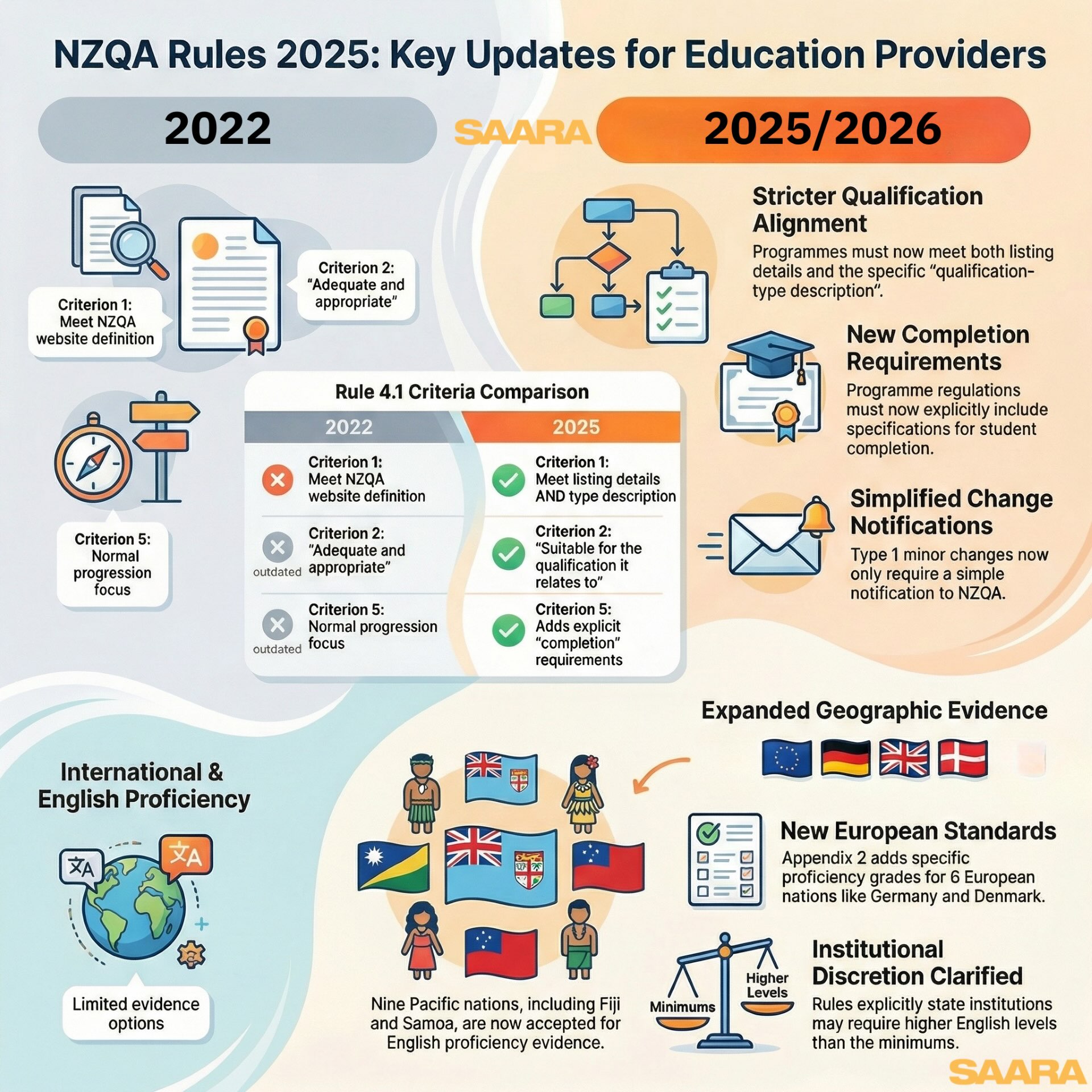
The 2025 Rules sharpen what “good” looks like in programme design, make some change notifications simpler, and expand English proficiency pathways for international admissions.
If you only take one action, make it this.
Review your programme documentation against Rule 4.1, and check your programme regulations include clear completion requirements.
Review your programme documentation against Rule 4.1, and check your programme regulations include clear completion requirements.
1) Stricter qualification alignment and programme criteria (Rule 4.1)
Criterion 1: Qualification alignment is now more explicit
Under the 2022 Rules, the programme had to meet the NZQA website definition for the applicable qualification type.
Under the 2025 Rules, programmes must meet both the listing details for the qualification and the qualification-type description.
What this means in practice
Your application needs to show a clear line of sight between your programme structure and the qualification listing details, plus how it fits the qualification type expectations.
Your application needs to show a clear line of sight between your programme structure and the qualification listing details, plus how it fits the qualification type expectations.
Criterion 2: The standard is now “suitable”
The 2025 Rules state the title, aims, learning outcomes, and coherence must be “suitable for the qualification it relates to”.
This replaces the 2022 phrasing that these elements must be “adequate and appropriate” and clearly meet the graduate profile and specification.
What this means in practice
Be ready to explain why your design choices make sense for that qualification, not just that they exist on paper.
Be ready to explain why your design choices make sense for that qualification, not just that they exist on paper.
Criterion 5: Regulations now need “completion”, not only progression
In 2022, programme regulations had to specify normal progression within the programme.
In 2025, regulations must specify normal progression and completion.
What this means in practice
Define what “completion” looks like for a learner in your context.
For example, you may need clearer statements about final assessments, required practical evidence, attendance or participation thresholds, resubmission rules, and any “must-complete” components.
Define what “completion” looks like for a learner in your context.
For example, you may need clearer statements about final assessments, required practical evidence, attendance or participation thresholds, resubmission rules, and any “must-complete” components.
2) Streamlined administration for programme changes (Rule 16)
Type 1 changes: simpler notification
A “Type 1 change” is a change that does not impact the programme as a whole.
In 2022, institutions had to notify NZQA of amendments that resulted in changes to the Data Requirements.
In 2025, the requirement is simpler.
Before you carry out a Type 1 change, you must notify NZQA of the change.
Before you carry out a Type 1 change, you must notify NZQA of the change.
Type 2 changes: no approval required
A “Type 2 change” is a change that does have an impact on the programme as a whole.
As at February, 2026, Type-2 changes no longer require ISB notification.
What this means in practice
If you are planning substantive programme redevelopment, treat it as a structured change project.
Build an evidence pack that shows the programme still meets Rule 4.1, includes internal quality assurance approval, and clearly identifies impacts.
If you are planning substantive programme redevelopment, treat it as a structured change project.
Build an evidence pack that shows the programme still meets Rule 4.1, includes internal quality assurance approval, and clearly identifies impacts.
3) Expanded opportunities for international enrolments (Rule 22 and the appendices)
If your PTE recruits international students, Rule 22 is a key area to review.
Expanded Pacific nations (Rule 22.5)
The list of countries accepted for the prior-education pathway now includes nine Pacific nations: Fiji, Kiribati, Nauru, Papua New Guinea, Samoa, Solomon Islands, Tonga, Tuvalu, and Vanuatu.
New European standards (Appendix 2)
Rule 22.3(d) allows evidence that a student met the English level and grade specified for certain European countries in Appendix 2.
Appendix 2 includes country-specific requirements and grades.
For example, Denmark includes Studentereksamen English A grade 7 or English B grade 10.
For example, Denmark includes Studentereksamen English A grade 7 or English B grade 10.
More detailed test verification and test conditions (Appendix 1)
Appendix 1 includes general and test-specific criteria, including requirements about authorised test centres, single score reports, and verification through the test provider.
Examples include:
-
IELTS must be taken at an official IELTS test centre, with scores from a single Test Report Form, and IELTS One Skill Retake can be accepted.
-
TOEFL iBT must be taken entirely at an authorised test centre, the iBT paper edition cannot be accepted, and “My Best Scores” cannot be accepted.
What this means in practice
This is not just an admissions update.
It affects what evidence you collect, what you store, and what you can accept.
This is not just an admissions update.
It affects what evidence you collect, what you store, and what you can accept.
4) Institutional discretion is now clearer (Rule 22.6)
The 2025 Rules explicitly confirm two important points:
-
Institutions can require a higher level of English proficiency evidence than the minimums in Rule 22.
-
Meeting the minimums does not require an institution to enrol a particular student.
What this means in practice
You can set an admissions standard that fits your delivery model, learner support capacity, and safety and quality expectations, as long as it is applied fairly and documented well.
You can set an admissions standard that fits your delivery model, learner support capacity, and safety and quality expectations, as long as it is applied fairly and documented well.
5) Updates to Te Hono o Te Kahurangi (Rule 12.2)
If you request assessment using Te Hono o Te Kahurangi quality assurance, the 2025 Rules add a new documentation requirement.
Applicants must provide the information the framework and tools require, including a self-reflective summary showing how the applicant meets the criteria expressed through ngā kaupapa.
Applicants must provide the information the framework and tools require, including a self-reflective summary showing how the applicant meets the criteria expressed through ngā kaupapa.
The 2022 Rules required information the framework and tools require, but did not explicitly call out the self-reflective summary.
What this means in practice
Start early.
Good self-reflection is easier when it is built from real evidence and real practice, not written in a rush.
Start early.
Good self-reflection is easier when it is built from real evidence and real practice, not written in a rush.
Is your PTE ready for the 2025 Rules?
If you have not refreshed your programme documentation since the 2022 framework, it is worth doing a structured review now.
How SAARA can support you
We work with PTEs across the compliance lifecycle, including:
-
Programme approval support, including documentation alignment to Rule 4.1
-
Updating programme regulations to define completion clearly
-
Change management support for Type 1 and Type 2 changes
-
Admissions evidence reviews for Rule 22, including Appendix 1 and Appendix 2 pathways
-
Te Hono o Te Kahurangi preparation, including self-reflective summary coaching and evidence mapping