The January 2026 regulatory rollover brought major change to the vocational education sector, including the introduction of NZQA’s integrated Quality Assurance Framework (iQAF).
While much of the sector’s attention has focused on the end of EERs, another important change also needs immediate attention from Private Training Establishments (PTEs): the relocation and update of the sub-contracting rules.
If your PTE works with another organisation to deliver education or training, it is essential to understand what has changed, what must happen before delivery begins, and what this means for your Quality Management System (QMS).
Where have the sub-contracting rules moved to?
Previously, sub-contracting requirements sat within the Programme Approval, Recognition, and Accreditation Rules.
From 19 January 2026, those provisions were removed from the Programme Rules.
They now sit within the Quality Assurance of Tertiary Education Providers Rules 2026.
This change signals that sub-contracting is no longer treated as simply a programme-level administrative matter. It is now part of your wider organisational quality assurance and self-review responsibilities.
Rule 8 of the new framework sets out how PTEs must manage sub-contracting arrangements.
Which process applies will depend on whether your chosen sub-contractor already holds the relevant accreditation or consent to assess.
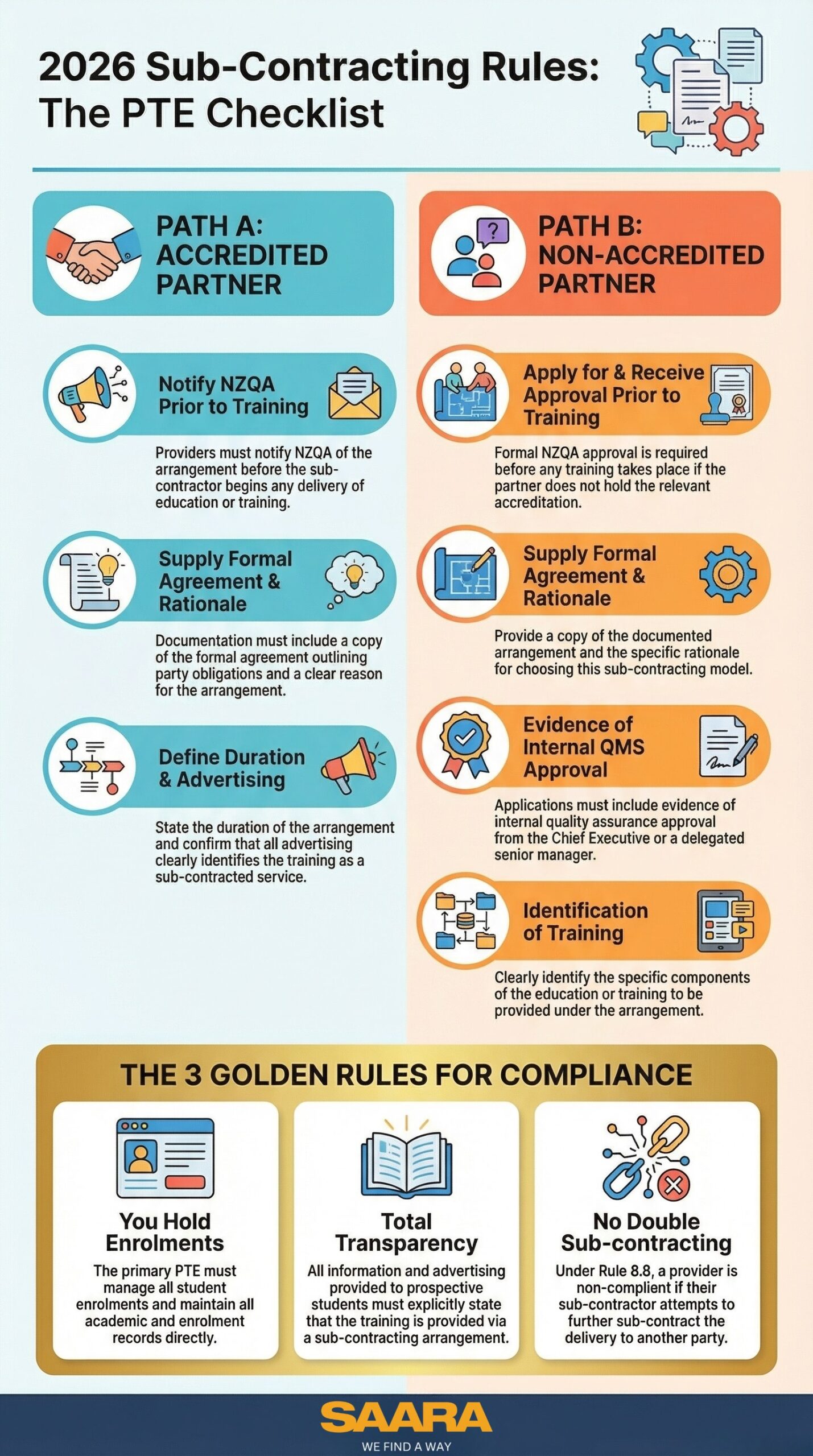
Pathway 1: Using an accredited sub-contractor
If your sub-contractor already holds its own accreditation for the same programme or micro-credential, or already has consent to assess against the specific standards being delivered, the process is more straightforward.
Even so, delivery cannot begin without action from your PTE.
You must notify NZQA before the sub-contractor provides any education or training.
Your notification must include:
A copy of the sub-contracting agreement, clearly outlining the responsibilities and obligations of both parties
The duration of the arrangement
The reasons for entering into the arrangement
Confirmation that advertising and information for prospective students clearly states the training is delivered under a sub-contracting arrangement
Pathway 2: Using a non-accredited sub-contractor
If your partner organisation does not hold accreditation for the programme or micro-credential, or consent to assess for the standards being delivered, notification will not be enough.
In that situation, you must apply to NZQA for approval before any training takes place.
This pathway requires a greater level of evidence to show that suitable quality assurance is in place.
Your application must include:
The name of the sub-contractor and the specific education or training they will provide
The rationale for the arrangement
A copy of the formal sub-contracting agreement
Evidence of internal quality assurance approval signed by your Chief Executive, or by a senior manager with delegated authority from the CE
NZQA will only approve the arrangement if it is satisfied that your PTE remains fully responsible for ensuring the sub-contractor meets all relevant obligations under the Act.
The formal agreement must also include provisions allowing NZQA to exercise its quality assurance and enforcement powers in relation to any acts or omissions of the sub-contractor.
Three golden rules for all sub-contracting arrangements
Whether your sub-contractor is accredited or non-accredited, the 2026 Quality Assurance Rules require ongoing compliance in three key areas.
- Your PTE must hold the enrolments and academic records
Even where the sub-contractor is delivering the training, all student enrolments must remain with your tertiary education provider.
Your PTE must also maintain all student enrolment and academic information.
- Marketing must be transparent
Your marketing and compliance processes need to align.
All advertising and information about the education or training must clearly state that delivery is taking place through a sub-contracting arrangement.
- No double sub-contracting
Under the 2026 rules, your PTE will be non-compliant if the sub-contractor you engage then attempts to sub-contract delivery to a third party.
Your agreements should clearly prohibit this.
What does this mean for your QMS?
Because sub-contracting now sits within the core Quality Assurance Rules, your QMS should be updated to reflect the 2026 requirements.
Your internal policies should clearly set out:
How sub-contractors are assessed and approved
How Chief Executive approval is documented
How student records are centrally maintained
How compliance with marketing and delivery requirements is monitored
Need an extra pair of hands?
SAARA Education works with organisations that need trusted support to design training, meet NZQA expectations, and build capability with confidence.
We bring practical expertise across programme design, compliance, and workforce development.
Whether you need a review of your sub-contracting agreements or support with the heavy lifting of your NZQA approval applications, we are here to help.
Contact SAARA today to help ensure your sub-contracting arrangements are compliant for 2026.